Evergreen Capital Solutions
Evergreen Capital Solutions
While Anthropic grapples with the paradox of AI’s threat to mankind and its “exponential”, bespoke capital solutions can help sponsor-backed companies from peak to trough of a credit cycle. Customizing capital solutions across loose, normal and stressed credit markets is what makes it an evergreen strategy. When included in the increasingly popular evergreen vehicles, these structures can become “evergreen” not just in form (always open) but also substance (ability to always deploy capital).
For example, aging leveraged loans and high-yield bonds raised during loose post-pandemic credit conditions face a wall of maturity beginning in 2028, where a rising rate environment poses refinancing and credit pressures. These dynamics afflict even sponsored loans (direct lending) residing in business development companies and interval funds. Capital solutions can be structured in myriad ways (see below). It can consolidate complex, multi-tranche debt stacks or even restructure dislocated public credits, opportunities typically targeted by traditional special situation investors.
If growth persists, however, capital solutions can help companies bypass traditional bank lending caps for M&A. As frequently observed in Asian markets, these structures provide discreet, flexible, and premium-priced holding company capital to fund organic or acquisitive growth without equity dilution. Unlike traditional lenders, capital solution providers are also quite flexible in accepting a broad collateral package including assets outside the operating company’s balance sheet. We see an exact parallel in asset-backed private credit structures financing bankruptcy-remote SPVs (of chip manufacturers and datacenter operators) that service their debt through contracted rental revenue from Tier-1 hyperscalers (Alphabet, Microsoft etc.). Of late, it has become quite common for public companies like Intel and Thryv Holdings to turn to capital solutions for bespoke financing, instead of issuing equity or debt in volatile public markets.
As middle-of-the-stack hybrid structures between senior debt and equity (with substantial first-loss equity cushion), capital solutions are typically non/less dilutive for sponsors and are typically shorter (3-5 years) tenors, targeting overall debt levels of 5-7x EBITDA, Loan to Value ~50%. The financing often takes one or more forms as below (with many other possibilities):
a) preferred equity with contractual priorities, liquidation preferences, and fixed returns
b) convertible securities with structural downside credit protection while giving the investor warrants, options, or conversion rights to capture equity upside
c) “Payment-in-Kind” where at the outset (thus “good” PIK) it is agreed to capitalize interest into the principal balance rather than paid in cash, thus conserving operating cash flows
d) junior capital e.g. second lien debt or subordinated debt to allow minority recapitalizations for partial realizations/liquidity for existing shareholders.
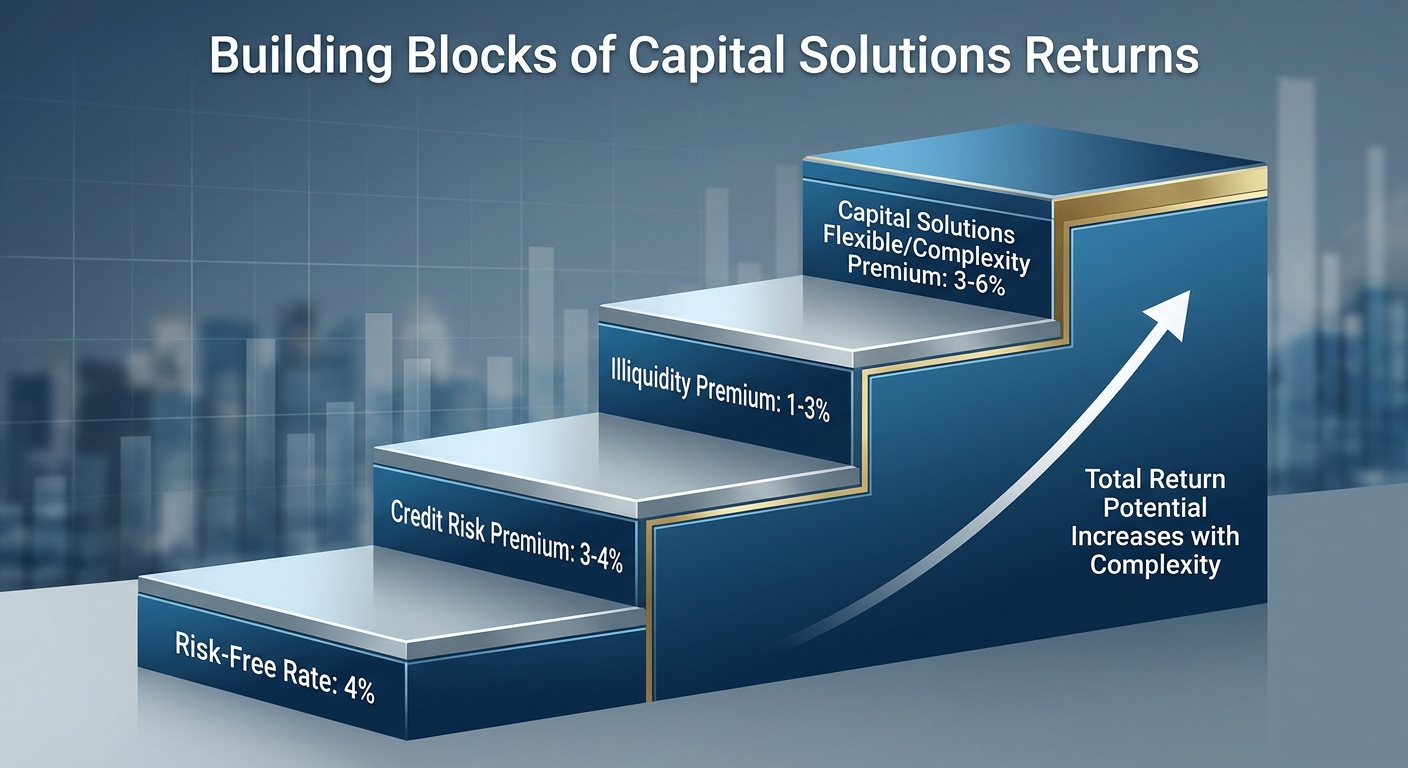
As evident, such tailored transactions create an asymmetric profile providing steady, high current income plus equity-like returns (often with contractual minimum returns) with lower loss severity than common equity. Investors can earn a premium for speed, flexibility, customization and complexity typically 300 to 600 basis points wide of traditional direct lending resulting in mid-teen 12-16% internal rates of return (IRRs). The contractual return right from inception helps reduce the J curve and enables early distributions (improving distributions to paid in capital).
Principal protection is secured through customized structures, collateral, covenants, liquidity controls, amortization schedules and maturities and governance rights (typically board seats and veto rights) to influence exits and other consequential decisions.
However, capital solutions require far more versatile and creative structuring expertise to navigate idiosyncratic risks than traditional, cookie-cutter sponsored direct lending does. A robust internal legal team, paired with an extensive external network, is critical to negotiating and structuring complex provisions related to priority, enforcement, governance, information rights, exit mechanics and downside protection.
Equally vital are deep origination networks capable of sourcing proprietary deal flow to efficiently deploy continuous inflows from evergreen vehicles. To help expand the opportunity set for a relatively capacity-constrained strategy, global managers with on-the-ground deal teams can tap into Asia ex-China (comprising over 10 investable countries) and Europe’s broader credit markets (representing 18 countries). Both regions offer structural and sector diversification with fewer ‘delayed’ defaults than the US. Moreover, it pays to understand varied regulations (e.g. Basel IV that will likely shift more bank lending to private credit) and disparate lender bases to recognize inefficiencies that lead to structurally wider spreads.
Capital solutions should therefore occupy a more prominent role within the growing alternative credit sleeve of evergreen funds. This shift would provide essential diversification away from traditional direct lending, which allocators heavily piled into during the post-pandemic boom of 2021–22. This should also help diversify alternative credit’s present-day concentration in asset-based finance (ABF), as its underlying collateral pools consisting of credit cards, auto/consumer loans, equipment leases etc. remain exposed to consumer and corporate credit stress in an inflationary and rising rates environment.
Mounting corporate and fiscal debt, geopolitical conflicts disrupting energy supply chains, and fierce competition for growth capital collectively point to a tighter credit cycle. In this environment, creative capital solutions designed for both stressed credit situations and corporate growth objectives become highly compelling. The creative ability of capital solutions to deploy flexible capital in diverse situations through all phases of the credit cycle would thus render evergreen fund structures more “evergreen” in both form and substance.
LPs seeking an opinion on evergreen funds and GPs looking to launch evergreen products, are welcome to contact EMA for a preliminary discussion.
Kamal Suppal
Chief Investment Auditor
October 28, 2026
The above content is intended for accredited/qualified/sophisticated audiences as in institutional investors or family offices. Readers are advised that any theme or idea discussed above is not an offer to buy or sell any investment.